ECIU logo
Image for learning opportunity Healthcare and Sustainable Mobility (HASMO)
challenge

Healthcare and Sustainable Mobility (HASMO)

Healthcare and Sustainable Mobility (HASMO)

Design the future mobility for rehabilitation and fight against sedentary lifestyle
Open for application

Our Challenge

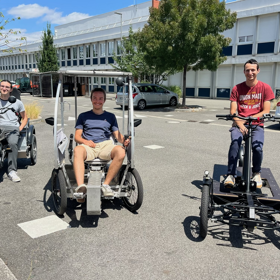
Do you know what “Véli” are? It’s the French name for “carbikes”, light and active vehicles between bikes and cars for sustainable transport. In this challenge, you will work on health applications for “vélis”.  You will study the link between physical and mental health and know more about “vélis” equipped with physical activity monitors, like heart frequency sensors. Surveys on and interviews with potential patients and prescribers will help you to analyse their specific needs. You will address the implementation of several connected health sensors for a better management of health parameters. You will tackle the challenge of developing these new modes of sustainable mobility to fight sedentary or rehabilitation of patients after surgery or treatments and develop strategies to implement this approach in the future health system. In particular, at least one student groupe will adapt a "véli" for a family with a 4-year-old child with special needs. The parents want to do a trip to the ocean in summer '26 because the child loves cycling and might not be able to see the ocean later. They also want to make other people aware of this handicap and raise money for a fund to fight it. The "véli" will need protection against wind and rain, a trailer for a little fridge for medicine and a special seat for the child. Together with the parents, you will design the perfect "véli" for this trip. During the mobility week in Toulouse from 16th to 20th of March , you will test different velis, make interviews, organise véli tests with potential users (patients) and analyse their feedback. Experts will give lectures to complete your knowledge. Intercultural workshops and visits will round off the mobility week's programme.  You will present your results and conclusions with your small international student’s group at the end of the challenge.

The Team

KA
Profile photo
Katja Auffret
Teamcher
GS
Profile photo
Georges Soto-Romero
Teamcher
0 learners
Study format
Blended
Application period
8 December 2025 – 2 February 2026
Study period
23 February – 18 May 2026
Credits
3 ECTS
Hosting university
INSA Group
Got questions?Reach out to us via this 

Learning outcomes

Design innovative mobility solutions for health

By the end of this challenge, you will be able to design and develop innovative mobility solutions that address health-related needs, drawing on creativity, user-centred thinking, and technological design principles.

ESCO SKILLS

Use connected health sensors for mobility solutions

By the end of this challenge, you will be able to use and combine connected health sensors to support the development of mobility solutions, selecting and integrating digital tools appropriately for specific user needs.

ESCO SKILLS

Collaborate across cultures and disciplines

By the end of this challenge, you will be able to communicate and collaborate effectively with peers from different cultural and disciplinary backgrounds, adapting your communication style and contributing constructively to teamwork.

ESCO SKILLS

Work in an international interdisciplinary team

By the end of this challenge, you will be able to work effectively in an interdisciplinary and international team and present your methodology and key results clearly in a foreign language.

ESCO SKILLS

Potential progress

This graph shows the potential you could reach if you take this learning opportunity and how it fits your goal. You can also make a comparison to your current and potential competencies by pressing the buttons.

Less than 5
5 or more
Goal based on on your motivation scan

We recommend to turn your device to view graph

Not sure which competencies suit you?

Take our motivation scan to find learning opportunities that will help you reach your potential goal and growth.

Information

During a previous challenge (VESACCO) followed by internships in which students worked on the needs analysis and prototyping of a ‘health véli’, the students validated algorithms linking the electric assistance of the vélis to the users' heart rates.

In this challenge, with the support of the challenge provider, the University Hospital of Toulouse, you will also study the influence of physical activity on mental health.

Several vélis on the INSA campus are now ready for testing with volunteer patients, and the influence on their physical as well as their mental health will be surveyed. As mentioned, you will also work on the specific case of the 4-year-old child with specific needs.

You will conduct these surveys in cooperation with prescribers (doctors, physiotherapists, etc.) and patients (potential users) in order to refine the needs analysis and propose modifications to existing vélis to adapt them for use in the health sector.

However, before beginning this work on the challenge itself, work on interculturality will be carried out at the beginning of the course (defining one's strengths and weaknesses in the intercultural field and areas for improvement by establishing one's intercultural profile, tutorials on interculturality with theories and the Iceberg model) in order to facilitate cooperation between students with different profiles.

At the end of the challenge, each international student team will formulate proposals for adapting existing velis for use in the health sector. You will develop ideas to have velis recognised as a medical device for combating sedentary lifestyles, for using velis as a means of rehabilitation and for promoting mental health.

With your group, you will give presentations on the main results of your surveys and analyses in front of a jury and you will present your results in a report.  What is more… You can follow the challenge in Spanish or German if you wish!

Hosting university

INSA Group

INSA Group

Challenge provider

CHU (University Hospital) of Toulouse