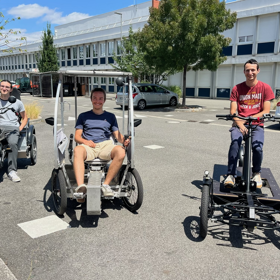
During a previous challenge (VESACCO) followed by internships in which students worked on the needs analysis and prototyping of a ‘health véli’, the students validated algorithms linking the electric assistance of the vélis to the users' heart rates.
In this challenge, with the support of the challenge provider, the University Hospital of Toulouse, you will also study the influence of physical activity on mental health.
Several vélis on the INSA campus are now ready for testing with volunteer patients, and the influence on their physical as well as their mental health will be surveyed. As mentioned, you will also work on the specific case of the 4-year-old child with specific needs.
You will conduct these surveys in cooperation with prescribers (doctors, physiotherapists, etc.) and patients (potential users) in order to refine the needs analysis and propose modifications to existing vélis to adapt them for use in the health sector.
However, before beginning this work on the challenge itself, work on interculturality will be carried out at the beginning of the course (defining one's strengths and weaknesses in the intercultural field and areas for improvement by establishing one's intercultural profile, tutorials on interculturality with theories and the Iceberg model) in order to facilitate cooperation between students with different profiles.
At the end of the challenge, each international student team will formulate proposals for adapting existing velis for use in the health sector. You will develop ideas to have velis recognised as a medical device for combating sedentary lifestyles, for using velis as a means of rehabilitation and for promoting mental health.
With your group, you will give presentations on the main results of your surveys and analyses in front of a jury and you will present your results in a report. What is more… You can follow the challenge in Spanish or German if you wish!