Sustainable Process Design Project
Sustainable Process Design Project
Our Challenge
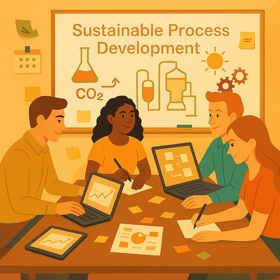
In this project-based course, student teams design a sustainable chemical process starting from carbon dioxide (CO₂) as a raw material. Each team selects an individual product—such as methanol, formic acid, or synthetic fuels—and develops a process route for its conversion. Throughout the course, students apply principles of green chemistry, assess carbon capture and utilization (CCU) technologies, and construct a complete process design including component data, mass and energy balances, and simulation models. Core activities include flowsheet development, sustainability evaluation using KPIs, and integration of industrial insights. The course combines technical depth with creative problem-solving and encourages systems thinking and collaboration. Feedback loops and structured consultations guide the iterative development of each project. As a final outcome, teams present their designs to a jury and receive detailed feedback. Participants also have the opportunity to submit their work to the international EFCE student competition (EURECHA), gaining further visibility and recognition.
The Team
Teachers
These are the teachers you'll work with on the challenge.
Learners
- Study period
- 13 October 2025 – 30 January 2026
- Study format
- Hybrid
- Application period
- 1 December – 1 December 2025
- Credits
- 6 ECTS
- Hosting university
- Hamburg University of Technology
- EQF Level
Master Level
Information
Value and progress
Soft skills relating to interdisciplinary and international collaboration
By the end of the Challenge learners will cultivate soft skills relating to interdisciplinary and international collaboration, critical thinking, communication, ideation, and collective creativity.
ESCO SKILLS
Problem solving in complex and practical tasks by designing an integrated chemical process
The course aims to foster the ability of the students to apply their technical skills to complex and practical tasks and enhancing their problem-solving skills.
ESCO SKILLS
Not sure which competencies suit you?
Take our motivation scan to find learning opportunities that will help you reach your potential goal and growth.
Hosting university
Hamburg University of Technology

Associated Partners