
Telecommunications Services With Net-Zero Emissions
Telecommunications Services With Net-Zero Emissions
Our Challenge
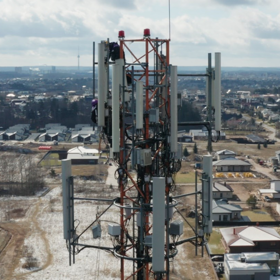
Although the ICT sector itself contributes around 2 to 2.5 percent of global GHG emissions, it is recognized worldwide for consuming large amounts of electricity and energy mostly due to the operations of data centers and base stations. There are also other issues related to the extensive use of equipment for networks, CPE equipment, and a large number of electronic devices. Electricity, energy production and usage, equipment and electronic device manufacturing, as well as service provision, emit a huge amount of GHGs, which cause climate change. Although emissions related to the extraction of resources, production, and transportation of purchased equipment are not directly associated with Telia activities, they are counted as indirect emissions of the Telia. Currently, the largest portion of Telia emissions consists of indirect emissions. In 2023, such emissions accounted for a staggering 97%. The largest portion of indirect emissions from the company is comprised of mobile phones and other CPE equipment for clients, as well as network equipment, along with all associated construction and maintenance work. Despite the organization's efforts to renew customer CPE equipment, accept old equipment from customers, and solely use electricity from renewable sources, as well as implementing various other solutions, achieving a net-zero target throughout the value chain remains a significant challenge. It's widely acknowledged that without collaboration with stakeholders, reducing value chain emissions is unattainable, and such decisions are crucially linked with service innovations. What future telecommunication services would require what type of equipment or not? What would future client expectations be? This is the ultimate goal we are trying to project. What net-zero solutions could be suggested? Please be brave and project vividly, and be part of a huge and powerful transformation where all the world's businesses are focusing on in the face of climate change.
The Team
Teamchers
These are the teamchers you'll work with on the challenge.
Learners
Challenge providers

- Study period
- 3 October – 19 December 2024
- Study format
- Online
- Application period
- 15 June – 22 September 2024
- Credits
- 6 ECTS
- Hosting university
- Kaunas University of Technology
- Topics
Information
Value and progress
Create and present ideas and prototypes
Create and effectively present innovative ideas and developed prototypes tailored to the requirements of unique audience.
ESCO SKILLS
Pinpoint research direction
Self-sufficiently pinpoint a unique and impactful research direction, utilizing existing knowledge and acquired competencies.
ESCO SKILLS
Tackle real-world issues
Innovatively tackle complex real-world issues using the core tenets of challenge-based learning methodology.
ESCO SKILLS
Utilise teamwork and leadership principles
Utilise effective teamwork and leadership principles while collaborating within diverse, interdisciplinary teams.
ESCO SKILLS
Not sure which competencies suit you?
Take our motivation scan to find learning opportunities that will help you reach your potential goal and growth.
Hosting university
Kaunas University of Technology

Challenge provider