
Building cities of the future: harnessing new urban bioresources
Building cities of the future: harnessing new urban bioresources
Our Challenge
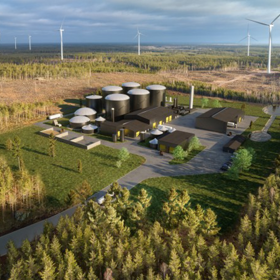
Cities and their surrounding rural areas generate vast amounts of organic resources, from manure and crop residues to food and agricultural by-products. These materials hold great potential for producing renewable energy and strengthening sustainable food systems, yet they are often underused or seen as competing with food and feed production. In this challenge, you will explore how biogas production can be effectively integrated with agriculture in ways that create value for both farmers and energy systems. Together with St1 Biokraft, one of Northern Europe’s largest producers of bio-LNG, a sustainable and locally produced alternative to fossil fuels, you will investigate real-life examples where agricultural resources are used for biogas without compromising food production. Based on your findings, you will develop practical recommendations for how such approaches can be applied at St1 Biokraft’s new production facility in Mönsterås and you will contribute to shaping smarter, more circular solutions for energy and agriculture, helping drive the transition to a more sustainable future. The challenge is open to students from all backgrounds, blending engineering, natural sciences, and social studies to develop cutting-edge solutions.
The Team
Teachers
These are the teachers you'll work with on the challenge.
Learners
Challenge providers

- Study period
- 28 September – 13 November 2026
- Study format
- Blended
- Application period
- 3 June – 7 September 2026
- Credits
- 5 ECTS
- Hosting university
- Linkoping University
- Topics
- Learner type
- Students
- EQF Level
Bachelor Level
Information
Value and progress
Communication skills
Communicate, orally and in writing, solutions to actors with diverse backgrounds and knowledge.
ESCO SKILLS
Generate solutions
Employ interdisciplinary perspectives on production and system integration of biogas and biofertilizer to develop realistic solutions to sustainable development challenges.
ESCO SKILLS
Problem identification
Identify and account for defined problems within predefined, broad, and reality-based challenges for sustainable development.
ESCO SKILLS
Not sure which competencies suit you?
Take our motivation scan to find learning opportunities that will help you reach your potential goal and growth.
Hosting university
Linkoping University

Challenge provider