
ECIU University Creathon 2026: Building Inclusive Futures: Care, Community and Mobility
ECIU University Creathon 2026: Building Inclusive Futures: Care, Community and Mobility
Our Challenge
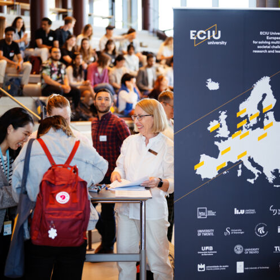
Rethink mobility. Reconnect territories. Shape inclusive futures. The ECIU University Creathon 2026 invites students to take part in an intensive, international challenge where mobility, care and community become levers for social and territorial transformation. From May 5 to 7, 2026, 50 students from across the ECIU Alliance will meet on-site at the Autonomous University of Barcelona (UAB) to co-create real, implementable solutions together with local organisations, public actors and researchers. Working in interdisciplinary teams, participants will tackle two interconnected challenges—one urban and one rural—focused on sustainable mobility, social inclusion and heritage, with the explicit aim of contributing to population retention, accessibility and quality of life across territories. The Creathon is a hands-on learning experience where ideas turn into prototypes, and where students can make a tangible impact on communities while developing key professional and transversal skills.
The Team
Teachers
These are the teachers you'll work with on the challenge.
Learners
Challenge providers

- Study period
- 7 April – 7 May 2026
- Study format
- Blended
- Application period
- 19 December 2025 – 1 February 2026
- Credits
- 2 ECTS
- Hosting university
- Universitat Autònoma de Barcelona
- Topics
- EQF Level
Bachelor Level
Information
Value and progress
Promote Design of Sustainable Infrastructure
By the end of the course, the learner is trained to design and propose urban infrastructure solutions that are environmentally sustainable, socially inclusive, and resilient, considering long-term impacts on cities and communities.
ESCO SKILLS
Innovative Mobility Solution
By the end of the course, the student is trained to develop innovative mobility strategies that enhance connectivity, accessibility, and sustainability in both urban and rural contexts, considering infrastructure, behavioural, and social factors.
ESCO SKILLS
Raise awareness on local community's priorities
By the end of the course, learners are able to identify, analyze, and explain the interconnections between urban and rural challenges, including depopulation, accessibility, economic activity, and social cohesion.
ESCO SKILLS
Stakeholder Engagement
Engage with local communities and stakeholders to understand needs, co-create solutions, and incorporate diverse perspectives.
ESCO SKILLS
Thinking holistically
By the end of the course, the learner is trained on how to design and implement collaborative research with different stakeholders.
ESCO SKILLS
Problem solving
By the end of the course, the student is trained on how to set their own learning goals and determine the resources and methods needed to achieve them.
ESCO SKILLS
Work in teams
Collaborative and Interdisciplinary Work: By the end of the course, the learner has had the experience of collaborating with students from different backgrounds and developing an interdisciplinary approach.
ESCO SKILLS
Not sure which competencies suit you?
Take our motivation scan to find learning opportunities that will help you reach your potential goal and growth.
Hosting university
Universitat Autònoma de Barcelona

Challenge providers