ECIU logo
Image for learning opportunity ECIU University Creathon 2026: Building Inclusive Futures: Care, Community and Mobility
challenge

ECIU University Creathon 2026: Building Inclusive Futures: Care, Community and Mobility

ECIU University Creathon 2026: Building Inclusive Futures: Care, Community and Mobility

Co-create inclusive mobility and heritage solutions for urban and rural Catalonia
Open for application

Our Challenge

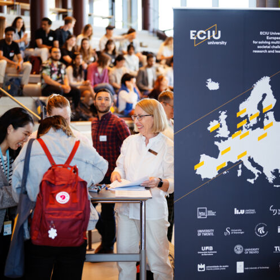
Rethink mobility. Reconnect territories. Shape inclusive futures. The ECIU University Creathon 2026 invites students to take part in an intensive, international challenge where mobility, care and community become levers for social and territorial transformation. From May 5 to 7, 2026, 50 students from across the ECIU Alliance will meet on-site at the Autonomous University of Barcelona (UAB) to co-create real, implementable solutions together with local organisations, public actors and researchers. Working in interdisciplinary teams, participants will tackle two interconnected challenges—one urban and one rural—focused on sustainable mobility, social inclusion and heritage, with the explicit aim of contributing to population retention, accessibility and quality of life across territories. The Creathon is a hands-on learning experience where ideas turn into prototypes, and where students can make a tangible impact on communities while developing key professional and transversal skills.

The Team

OM
Profile photo
Oscar Redondo Mora
Teamcher
0 learners
Study format
Blended
Application period
19 December 2025 – 1 February 2026
Study period
7 April – 7 May 2026
Credits
2 ECTS
Hosting university
Universitat Autònoma de Barcelona
Got questions?Reach out to us via this 

Learning outcomes

Promote Design of Sustainable Infrastructure

By the end of the course, the learner is trained to design and propose urban infrastructure solutions that are environmentally sustainable, socially inclusive, and resilient, considering long-term impacts on cities and communities.

ESCO SKILLS

Innovative Mobility Solution

By the end of the course, the student is trained to develop innovative mobility strategies that enhance connectivity, accessibility, and sustainability in both urban and rural contexts, considering infrastructure, behavioural, and social factors.

ESCO SKILLS

Raise awareness on local community's priorities

By the end of the course, learners are able to identify, analyze, and explain the interconnections between urban and rural challenges, including depopulation, accessibility, economic activity, and social cohesion.

ESCO SKILLS

Stakeholder Engagement

Engage with local communities and stakeholders to understand needs, co-create solutions, and incorporate diverse perspectives.

ESCO SKILLS

Thinking holistically

By the end of the course, the learner is trained on how to design and implement collaborative research with different stakeholders.

ESCO SKILLS

Problem solving

By the end of the course, the student is trained on how to set their own learning goals and determine the resources and methods needed to achieve them.

ESCO SKILLS

Work in teams

Collaborative and Interdisciplinary Work: By the end of the course, the learner has had the experience of collaborating with students from different backgrounds and developing an interdisciplinary approach.

ESCO SKILLS

Potential progress

This graph shows the potential you could reach if you take this learning opportunity and how it fits your goal. You can also make a comparison to your current and potential competencies by pressing the buttons.

Less than 5
5 or more
Goal based on on your motivation scan

We recommend to turn your device to view graph

Not sure which competencies suit you?

Take our motivation scan to find learning opportunities that will help you reach your potential goal and growth.

Information

Background

Many regions of Catalonia—particularly inland, rural and mountainous areas—are facing profound demographic and social transformations. Depopulation, ageing populations and declining economic activity are weakening social cohesion and threatening the preservation of cultural and natural heritage. Limited mobility and poor connectivity play a central role in these dynamics, restricting access to education, employment, healthcare and community life.

At the same time, urban areas are experiencing increasing pressure on their mobility systems. Traffic congestion, high transport costs and car-dependent infrastructures disproportionately affect students and young people, while limiting active mobility and access to green spaces. In this context, mobility is no longer just a technical issue, but a key factor shaping quality of life, social inclusion and environmental sustainability.

The Urban–Rural Perspective

The Creathon 2026 addresses these challenges through two complementary territorial lenses, each developed in close collaboration with local and regional stakeholders, ensuring that students work on real needs and realistic contexts. In both cases, the challenge explicitly explores how mobility and heritage can actively contribute to retaining and attracting population, particularly young people, in territories affected by demographic decline.

In Cerdanyola del Vallès, the urban challenge focuses on the transformation of the Riu Sec, a dry riverbed that crosses the city and connects it to the UAB campus. Despite the geographical proximity, the campus remains poorly integrated into the city’s daily life. The challenge invites students to rethink the Riu Sec and its surroundings as a structuring corridor for sustainable mobility, capable of linking neighbourhoods, the university and natural spaces, while enhancing ecological continuity and accessibility. This challenge is developed in collaboration with the Ajuntament de Cerdanyola del Vallès, which provides the institutional and territorial framework for the proposals.

In Pallars Jussà and Noguera, the rural challenge addresses the impact of limited mobility on depopulation, access to services and territorial cohesion. Heritage is approached not only as something to preserve, but as a strategic resource capable of generating access, economic opportunities, habitability and long-term population anchoring. Students will explore how innovative mobility solutions, heritage activation and the re-use of local assets can contribute to revitalising communities and creating attractive living environments. This challenge is carried out together with a network of key territorial actors: the Museu de Lleida, the Associació d’Iniciatives Rurals i Marítimes de Catalunya (ARCA), Geoparc Orígens, Ferrocarrils de la Generalitat de Catalunya (FGC), the Institut Ramon Muntaner (IRMU) and the University of Lleida, all of whom bring complementary perspectives on heritage, mobility, governance and rural development.

Objectives and Learning Experience

Through a challenge-based learning approach, students will work with real stakeholders to design context-sensitive, feasible solutions. The challenge builds on existing territorial strategies and mobility plans, translating them into concrete, place-based proposals at local scale. The Creathon offers a unique opportunity to:

  • apply academic knowledge to real-world problems;
  • collaborate in international and interdisciplinary teams;
  • engage directly with local communities and territories;
  • develop practical skills in co-creation, prototyping and communication.

By connecting urban and rural realities, the Creathon 2026 empowers students to imagine and build more inclusive, sustainable and connected futures.

Hosting university

Universitat Autònoma de Barcelona

Universitat Autònoma de Barcelona

Challenge providers

Cerdanyola City Council
Museu de Lleida
Association of Rural and Maritime Initiatives of Catalonia
Geoparc Orígens
Institut Ramon Muntaner