
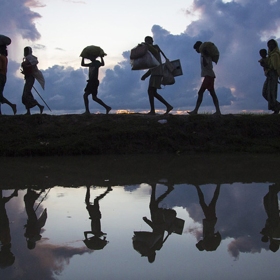
Climate change and migratory movements.
Climate change and migratory movements.
Our Challenge
Recently, the impact of climate change on human migration has become a prominent topic of discussion. This issue is quite complex, requiring more detailed information, particularly regarding migrations driven by extractive practices such as mining and those prompted by slow-onset climate changes, such as gradually rising sea levels, which make certain areas uninhabitable over time. These migrations frequently exacerbate global inequalities, as the individuals who suffer the most are often not the ones responsible for the environmental problems. Our aim is not only to raise awareness about these forced migrations but also to develop a better understanding of and solutions for addressing them.
The Team
Teachers
These are the teachers you'll work with on the challenge.
Learners
Challenge providers
- Study period
- 3 October – 19 December 2024
- Study format
- Blended
- Application period
- 29 July – 23 September 2024
- Credits
- 3 ECTS
- Hosting university
- Universitat Autònoma de Barcelona
- Topics
- Learner type
- EQF Level
Master Level
Information
Value and progress
Action-Research Design
By the end of the course, the learner is trained on how to design and implement collaborative research with different stakeholders.
ESCO SKILLS
Prototype Design
By the end of the challenge, the learner is trained on how to translate ideas into specific, action-oriented proposals.
ESCO SKILLS
Autonomous Learning
By the end of the course, the student is trained on how to set their own learning goals and determine the resources and methods needed to achieve them.
ESCO SKILLS
Collaborative and Interdisciplinary Work
By the end of the course, the learner has had the experience of collaborating with students from different backgrounds and developing an interdisciplinary approach.
ESCO SKILLS
Interdisciplinary Approach to the Main Issues Surrounding Climate Change and Refugees
By the end of the course, the learner has gained theoretical and practical knowledge about right to asylum and climate change consequences.
ESCO SKILLS
Formulation of Local Policies
By the end of the course, the student has gained experience in formulating solutions for local policies about asylum.
ESCO SKILLS
Development of indicators
By the end of the challenge, the student will be able to apply the appropriate indicators to study migratory movements and their causes.
ESCO SKILLS
Not sure which competencies suit you?
Take our motivation scan to find learning opportunities that will help you reach your potential goal and growth.
Hosting university
Universitat Autònoma de Barcelona

Challenge provider
Associated Partner
