Applied Computational Fluid Dynamics for Industrial Processes
Applied Computational Fluid Dynamics for Industrial Processes
Description
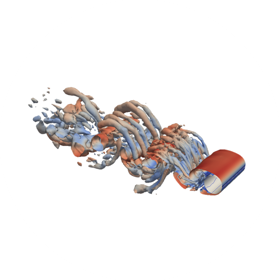
This course will teach you the practical application of computational fluid dynamics to solve industrial problems; that is, problems involving turbulent flow and complex geometries. The course uses the open-source software OpenFOAM.
The Team
Teachers
Meet the expert teaching staff, who is here to guide you through this learning opportunity.
Learners
- Study period
- 22 September – 7 November 2025
- Study format
- Hybrid
- Application period
- 7 March – 31 August 2025
- Credits
- 5 ECTS
- Hosting university
- University of Stavanger
- EQF Level
Master Level
Information
Value and progress
Knowledge
The students shall know: the most common models for turbulent flow; the basic criteria for mesh quality and how they affect simulation accuracy; relevant mathematical models within some of the following fields: aero/hydrodynamics, heat transfer, and multiphase flow.
ESCO SKILLS
Skills
The students shall be able to: perform simulations in the CFD software OpenFOAM (create simulation mesh, select initial- and boundary conditions, discretization schemes and solution methods and visualize the results); compare simulations against analytical and experimental results; implement mathematical models in OpenFOAM using C++ (if choosing the module on solver development)
ESCO SKILLS
General Competence
The students shall be able to: simplify practical problems to make them amenable for analysis with appropriate scientific methods; visualize and present data from simulations in a scientific manner; interpret results from simulations and evaluate accuracy and uncertainty.
ESCO SKILLS
Not sure which competencies suit you?
Take our motivation scan to find learning opportunities that will help you reach your potential goal and growth.
Hosting university
University of Stavanger