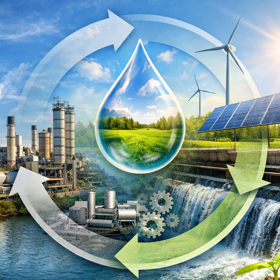
Transforming Industry through Reclaimed Water for a Circular Water Economy
Transforming Industry through Reclaimed Water for a Circular Water Economy
Our Challenge
Catalonia experienced very intense drought episodes between 2021 and 2025, which led to severe restrictions on water use, the implementation of extraordinary consumption management and control measures, as well as specific limitations for economic and industrial sectors. This context highlighted the vulnerability of the system and the need to optimise available water resources. Following this period, the strong dependence of industries on potable water has become especially evident, as has the significant but still underused potential of reclaimed water and the energy recovery from wastewater. Specifically, in Granollers (a municipality of around 65,000 inhabitants located 30 minutes from Barcelona), there is a highly relevant industrial base. The city is strategically positioned within the influence area of the Ter-Llobregat system, the main drinking water supply source for the Barcelona metropolitan area and its industrial surroundings. The recent situation of stress and emergency in this system has precisely highlighted the vulnerability of relying on a single source and the urgent need to reduce pressure on drinking water through alternatives such as reuse. In this context, the need to transform the current water management model in the industrial sector towards more resilient, efficient, and sustainable schemes becomes evident. Why is this important? - In Catalonia, industry accounts for between 15% and 25% of total water consumption in urban-industrial environments, making it a key actor in any water management strategy. - The industrial estates of Granollers host a wide variety of activities (food processing, chemical, and logistics) which results in highly heterogeneous water consumption patterns and, often, a strong dependence on potable water for uses that could be supplied with reclaimed water. Despite the availability of technical capacity, a favourable regulatory framework, and interest from companies, there is still no consolidated territorial model that enables the large-scale deployment of reclaimed water reuse. This includes its distribution among industries, integration with biogas generation systems, and the development of viable and sustainable business models. In this context, reclaimed water becomes the central element with huge transformative potential in this challenge. This challenge invites the development of concrete and applicable solutions that enable the transformation of industrial water management towards a more efficient, circular, and sustainable system, with a clear focus on the reuse of reclaimed water. It is not only about identifying problems, but about proposing real, impactful solutions. As a student, you have the opportunity to bring new perspectives, innovative ideas, and practical approaches that contribute to building a more resilient and future-ready water management model.
The Team
Teachers
These are the teachers you'll work with on the challenge.
Learners
Challenge providers
- Study period
- 27 April – 9 July 2026
- Study format
- Blended
- Application period
- 27 March – 20 April 2026
- Credits
- 3 ECTS
- Hosting university
- Universitat Autònoma de Barcelona
- Learner type
- Students
- EQF Level
Bachelor Level
Information
Value and progress
Action-Research Design
By the end of the course, the learner is trained on how to design and implement collaborative research with different stakeholders.
ESCO SKILLS
Prototype Design
By the end of the challenge, the learner is trained on how to translate ideas into specific, action-oriented proposals.
ESCO SKILLS
Autonomous Learning
By the end of the course, the student is trained on how to set their own learning goals and determine the resources and methods needed to achieve them.
ESCO SKILLS
Understanding and reducing environmental impacts in industrial systems
By the end of the course, the learner demonstrates the ability to identify environmental impacts and apply sustainable practices to reduce negative effects on ecosystems and local environments.
ESCO SKILLS
Promoting responsible use of resources in industrial production
By the end of the course, the learner is able to understand and promote responsible use of resources, especially in industrial systems, encouraging more efficient and sustainable consumption patterns.
ESCO SKILLS
Improving waste management and circular resource flows
By the end of the course, the learner is able to understand basic principles of waste management and propose strategies for reducing, reusing, and treating waste in an efficient and sustainable way.
ESCO SKILLS
Understanding economic models for circular water systems
By the end of the course, the learner gains an understanding of how circular economy models can be supported through sustainable financing mechanisms and innovative business models.
ESCO SKILLS
Promoting reuse and water sharing systems in industry
By the end of the course, the learner is able to identify opportunities for reuse and resource sharing, contributing to the reduction of consumption and the promotion of circular systems.
ESCO SKILLS
Not sure which competencies suit you?
Take our motivation scan to find learning opportunities that will help you reach your potential goal and growth.
Hosting university
Universitat Autònoma de Barcelona